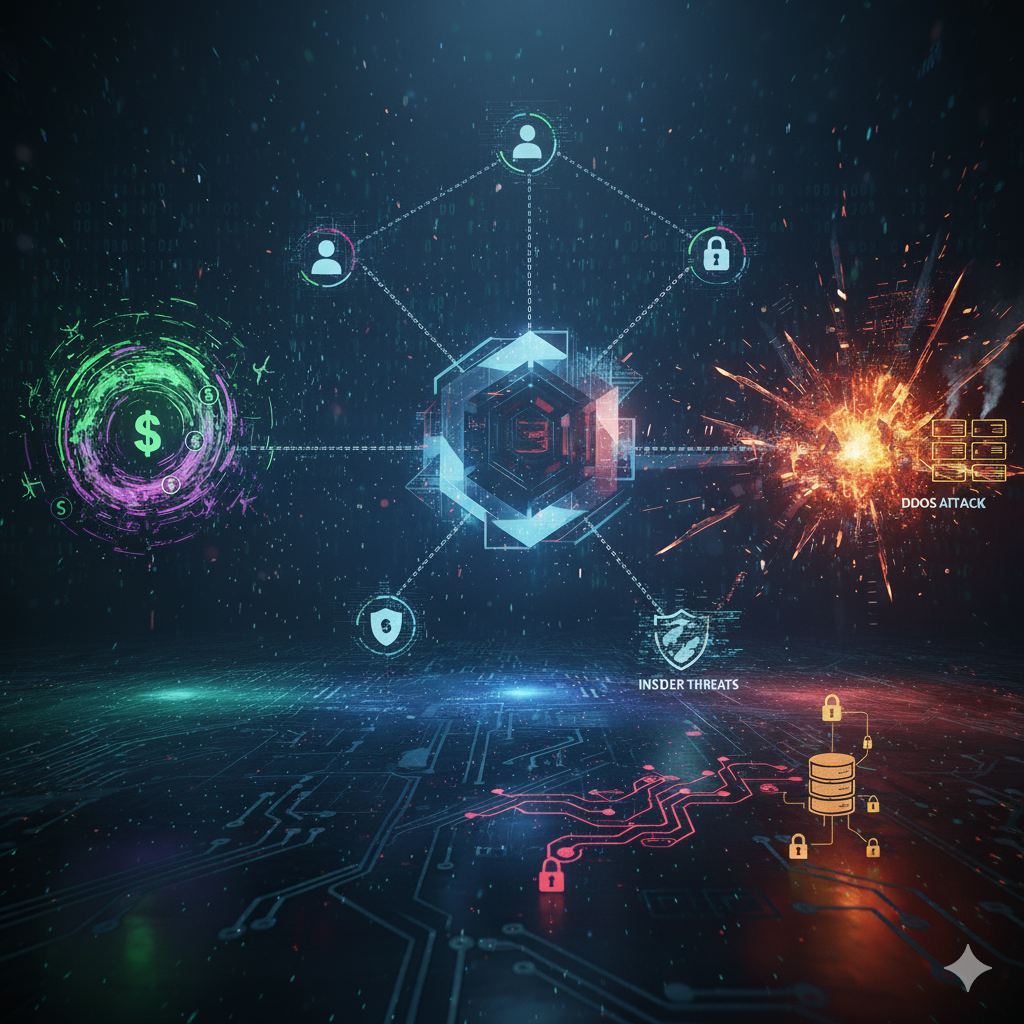
A threat represents any potential cause of harm to information systems, data, or digital services. It is not the incident itself, but the possibility of an event that exploits a vulnerability and causes damage, loss, or disruption. Threats reflect intent or potential for harm, while vulnerabilities represent the means by which that harm can occur.
Although the concept is longstanding, pioneers like Willis Ware (1970) identified threats to centralized computing systems, the modern context has expanded dramatically. From isolated mainframes to globally interconnected networks, threats now emerge wherever there is value to exploit, access to gain, or control to disrupt.
Modern organizations face threats across physical, digital, and human domains, including hackers, malware, insider mistakes, misconfigurations, supply chain compromises, and third-party service failures.
The Nature and Classification of Threats
Threats can be categorized by origin, intent, and target, providing insight into why they occur and guiding defensive strategies.
1. Nonhuman Threats: Environmental and Technical Events
Not all threats are malicious. Some arise from natural or accidental events that disrupt systems or destroy data. While often unpredictable, their impact can be mitigated with continuity planning and redundancy.
Examples include:
- Natural disasters: fires, floods, earthquakes, hurricanes affecting data centers or networks.
- Power failures or surges causing data loss or hardware damage.
- Hardware malfunctions: disk failures, memory corruption, or network cable faults.
- Software errors, incompatibilities, or firmware bugs leading to crashes or service interruptions.
- Environmental factors: overheating, humidity, or electromagnetic interference degrading performance.
Even unintentional, these events can be catastrophic. For instance, a data center outage in a financial institution could halt millions of transactions, impacting both revenue and reputation.
2. Human Threats: Nonmalicious Actions
Humans remain the weakest link in cybersecurity. Even well-intentioned employees can unintentionally cause harm through errors, omissions, or negligence.
Examples include:
- Accidentally deleting or overwriting critical files.
- Sending confidential information to the wrong recipient.
- Misconfiguring firewalls, databases, or cloud storage, exposing sensitive data.
- Ignoring security patches or software updates.
- Using weak or reused passwords across multiple systems.
Although nonmalicious, the consequences can mirror deliberate attacks. A 2017 cloud misconfiguration at a U.S. defense contractor exposed sensitive military files, not due to hacking, but human oversight. Awareness, training, and monitoring are therefore as critical for mitigating human error as technical safeguards like firewalls and encryption.
3. Human Threats: Malicious Actions
Malicious, human-driven threats are the most visible and costly. Actors intentionally seek to compromise confidentiality, integrity, or availability, motivated by financial gain, politics, ideology, or mischief.
Malicious threats can be further divided into:
- Random Attacks: Opportunistic and often automated, such as phishing campaigns, ransomware from spam emails, or drive-by downloads. Attackers scan the internet for any vulnerable systems, casting a wide net to ensnare unprepared targets.
- Directed Attacks: Targeted, carefully planned efforts against specific individuals, organizations, or industries. Examples include nation-state espionage, hacktivist operations, or cybercriminal campaigns against corporate financial systems. These attacks often involve reconnaissance, social engineering, and custom-crafted malware or exploits.
The distinction is often blurred in practice: a widespread ransomware campaign may begin randomly but evolve into a targeted extortion effort once attackers infiltrate a high-value enterprise network.
Small Use Case: Threat Awareness in a Mid-Sized Healthcare Organization
A regional healthcare network maintains electronic health records (EHRs), telemedicine services, and patient management systems. Understanding types of threats helps the organization prioritize defenses.
Approach:
- Nonhuman Threats: Deploy redundant power supplies, environmental controls, and failover systems to mitigate natural or technical disruptions.
- Nonmalicious Human Threats: Conduct regular staff training, enforce patch management, and implement access policies to prevent accidental errors.
- Malicious Threats: Implement threat intelligence, network monitoring, multi-factor authentication, and anti-malware solutions to detect and block both random and targeted attacks.
Outcome: The organization reduced the likelihood of unplanned downtime, prevented accidental data exposure, and strengthened defenses against sophisticated cyberattacks, ensuring continuity of patient care and compliance with healthcare regulations.