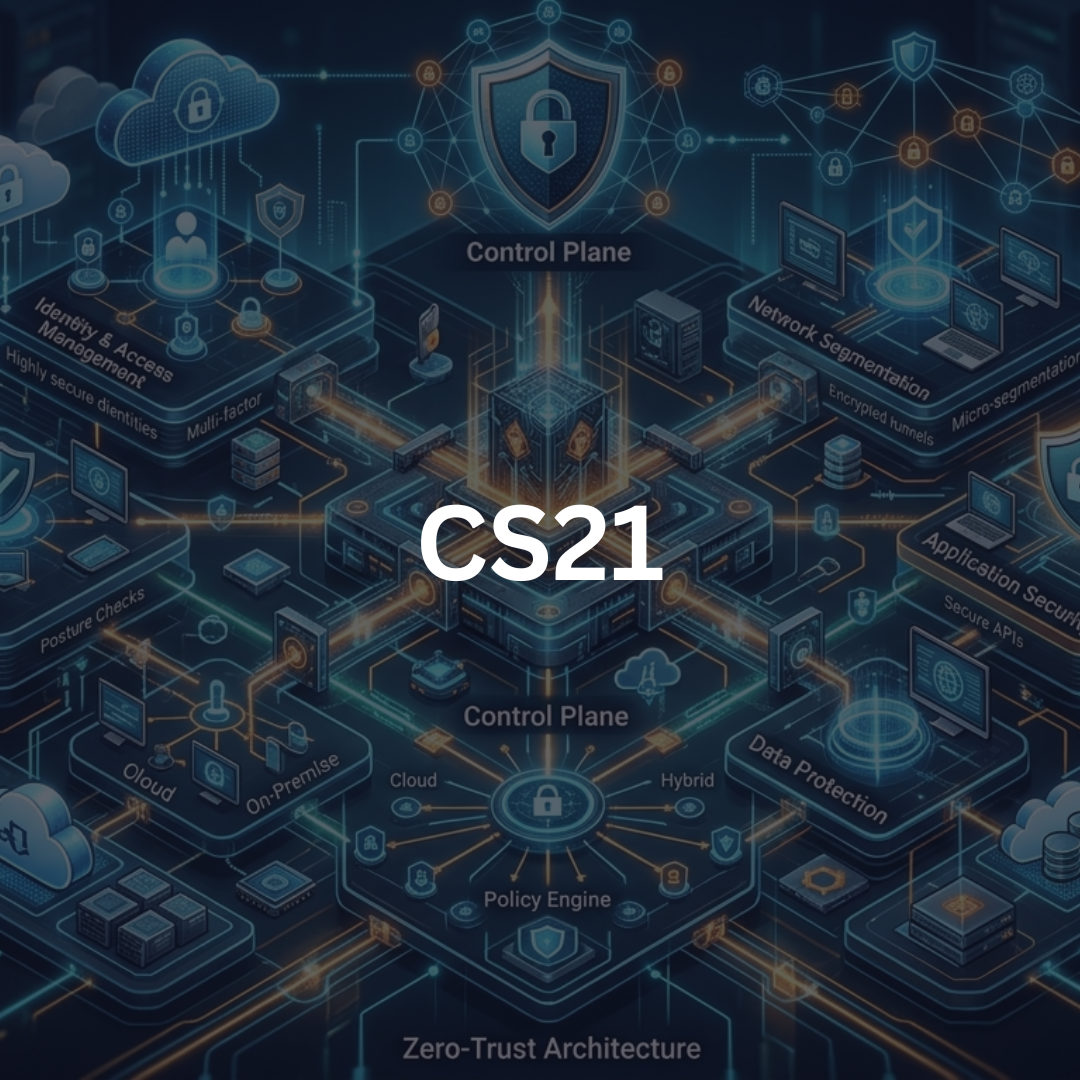
For decades, enterprise network security was built around a simple assumption: once a user or system was inside the corporate network, it could be trusted. This assumption gave rise to perimeter-based security models, where firewalls, VPNs, and intrusion detection systems were deployed primarily at the network edge. However, the modern enterprise no longer has a clear perimeter. Cloud computing, remote work, mobile devices, SaaS platforms, and third-party integrations have dissolved the traditional boundary between “inside” and “outside.”
Zero Trust Network Architecture (ZTNA) emerges as a direct response to this reality. Rather than assuming trust based on network location, Zero Trust enforces the principle that no user, device, application, or service should be trusted by default, regardless of whether it resides inside or outside the network. Every access request must be continuously verified, authorized, and monitored.
ZTNA is not a product or a single technology. It is an architectural paradigm that fundamentally reshapes how identity, access, networking, and security controls interact across the enterprise.
Conceptual Foundations of Zero Trust
The Zero Trust model is often summarized by the phrase “never trust, always verify.” While concise, this statement only scratches the surface of the architectural and operational implications of Zero Trust.
According to NIST SP 800-207, Zero Trust is built upon several foundational assumptions:
-
The network is always assumed to be hostile.
-
External and internal threats are treated with equal concern.
-
Access decisions are dynamic and context-aware.
-
Trust is not permanent and must be continuously evaluated.
These assumptions force a shift away from static network-based controls toward identity-centric and policy-driven security enforcement.
From Zero Trust to Zero Trust Network Architecture (ZTNA)
While Zero Trust is a broad security philosophy, Zero Trust Network Architecture (ZTNA) refers specifically to how network access is designed and enforced within this philosophy.
ZTNA replaces traditional network access mechanisms—such as full network VPNs—with application-specific, identity-aware access controls. Instead of granting users broad access to a network segment, ZTNA provides least-privilege access to individual resources, based on who the user is, what device they are using, and the current risk context.
In practical terms, ZTNA ensures that:
-
Users never directly connect to the internal network
-
Applications are hidden from unauthorized users
-
Network location is irrelevant to trust decisions
This approach dramatically reduces the attack surface and limits lateral movement.
Core Principles of ZTNA
ZTNA operationalizes Zero Trust through several core principles that work together to enforce granular and adaptive security.
- Identity-Centric Access Control
At the heart of ZTNA lies identity. Users, services, and devices must authenticate using strong, verifiable identities. Identity becomes the new perimeter, replacing IP addresses and network segments.
Identity validation typically includes:
-
Strong authentication (often multi-factor)
-
Device identity and posture validation
-
Integration with centralized identity providers
This aligns closely with ISO/IEC 27001:2022 access control requirements and modern identity governance practices.
- Least Privilege and Micro-Segmentation
ZTNA enforces least-privilege access by ensuring that users and systems can access only what they explicitly need, nothing more. This is achieved through fine-grained policies that define access at the application or service level.
Micro-segmentation further supports this principle by:
-
Isolating workloads and services
-
Preventing unauthorized lateral movement
-
Containing breaches when they occur
In contrast to traditional VLAN-based segmentation, ZTNA micro-segmentation is identity- and policy-driven, not topology-driven.
- Continuous Verification and Adaptive Trust
Trust in ZTNA is not binary or permanent. Instead, it is continuously evaluated based on real-time signals such as:
-
Authentication strength
-
Device security posture
-
User behavior patterns
-
Threat intelligence inputs
If risk conditions change, access can be dynamically restricted or revoked. This continuous verification model significantly improves resilience against credential theft and insider threats.
ZTNA Architecture Components
A mature ZTNA deployment consists of several interdependent architectural components working together.
- Policy Decision Point (PDP)
The Policy Decision Point evaluates access requests against defined security policies. It considers identity, device posture, context, and risk signals before making an allow or deny decision.
Policies are typically defined by security and governance teams and aligned with business requirements, following frameworks such as SABSA.
- Policy Enforcement Point (PEP)
The Policy Enforcement Point enforces the access decision. This component sits logically between the user and the application, ensuring that unauthorized traffic never reaches protected resources.
PEPs may be implemented as:
-
Cloud-based access brokers
-
Application gateways
-
Software agents on endpoints
- Identity Provider (IdP)
ZTNA relies heavily on centralized identity systems. The IdP authenticates users and provides identity assertions to the PDP.
Common integrations include:
-
Single Sign-On (SSO)
-
Multi-Factor Authentication (MFA)
-
Identity lifecycle management
- Device and Posture Assessment Systems
ZTNA evaluates not only who the user is, but also the security state of their device. This includes checking:
-
OS patch levels
-
Endpoint protection status
-
Encryption and configuration compliance
This capability aligns directly with COBIT 2019 control objectives and enterprise risk management practices.
ZTNA vs Traditional VPN-Based Access
Understanding the differences between ZTNA and traditional VPNs is essential for appreciating its security value.
Traditional VPNs:
-
Provide broad network access
-
Rely on network location for trust
-
Increase lateral movement risk
-
Expand the attack surface
ZTNA:
-
Provides application-level access
-
Enforces identity-based trust
-
Minimizes lateral movement
-
Conceals internal infrastructure
From an attacker’s perspective, ZTNA removes the visibility and reach that VPNs often unintentionally provide.
ZTNA in Cloud and Hybrid Environments
Modern enterprises operate across on-premises, cloud, and hybrid infrastructures. ZTNA is particularly well-suited to these environments because it is location-agnostic.
ZTNA enables:
-
Secure access to SaaS applications
-
Protection of cloud-native workloads
-
Unified access policies across environments
The Cloud Security Handbook (O’Reilly) emphasizes ZTNA as a foundational control for cloud security architectures, especially when combined with identity federation and workload identity.
Governance, Risk, and Compliance Alignment
ZTNA is not merely a technical solution; it is a governance-enabling architecture.
From a compliance perspective, ZTNA supports:
-
ISO/IEC 27001 access control requirements
-
Auditability of access decisions
-
Enforcement of segregation of duties
-
Risk-based access management
Frameworks like COBIT 2019 help ensure that ZTNA deployments are governed, measured, and continuously improved.
ZTNA and SABSA Alignment
From a SABSA perspective, ZTNA fits naturally within a business-driven security architecture.
-
Business requirements define access policies
-
Risk analysis determines trust conditions
-
Controls are selected to enforce those policies
-
Continuous monitoring ensures accountability
This traceability ensures that ZTNA is not deployed as a reactive technology, but as a strategic security capability.
Operational and Cultural Challenges
While ZTNA offers significant security benefits, its adoption requires organizational maturity.
Common challenges include:
-
Legacy application compatibility
-
Identity infrastructure readiness
-
Cultural resistance to access restrictions
-
Policy complexity management
Successful ZTNA adoption requires close collaboration between security, IT operations, application owners, and executive leadership.
Educational Value for Cybersecurity Students
For students and early-career professionals, understanding ZTNA develops critical skills:
-
Systems thinking beyond individual controls
-
Identity and access management expertise
-
Risk-based architectural decision-making
-
Alignment of security with business strategy
ZTNA knowledge is increasingly essential for roles such as:
-
Security architect
-
Cloud security engineer
-
Zero Trust program lead
-
Enterprise risk advisor
ZTNA as the Foundation of Modern Enterprise Security
Zero Trust Network Architecture represents a fundamental shift in how enterprises design and enforce security. By eliminating implicit trust, centering access decisions on identity, and continuously evaluating risk, ZTNA provides a resilient and scalable model for modern digital environments.
When implemented within structured frameworks such as SABSA, governed through COBIT, and aligned with ISO/IEC 27001, ZTNA becomes more than a technical solution—it becomes a strategic security architecture capable of supporting long-term organizational trust, resilience, and digital transformation.